
AI-generated conceptual cover. It evokes a document collection and its summaries; it does not represent the method’s architecture or experimental results.
Lately, I had been wondering how much code was being generated with AI worldwide and how many programmers still wrote everything by hand. Investigating those questions would mean looking in many places: surveys, studies of GitHub repositories, Stack Overflow posts, and company reports. Each source might contribute part of the story, but we would need to check what it actually measures and which conclusions we can draw from it.
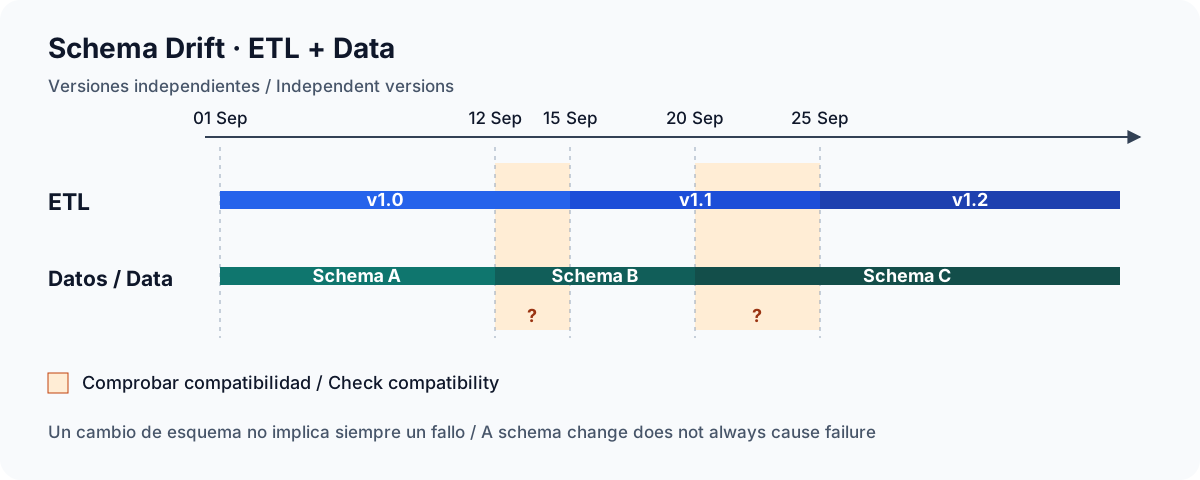
Every morning, an ETL receives a CSV, converts ages to integers, and loads customers. Yesterday it worked with this file:
id,name,age
1,John,25
2,Mary,30
Today, the provider adds a country:
id,name,age,country
1,John,25,USA
2,Mary,30,UK
A few days later, another surprise arrives:
id,name,age,country
1,John,25,USA
2,Mary,unknown,UK
An additional column may be harmless if we select fields by name and allow extra columns. If we unpack each row into three variables, it may break the load. unknown may cause an age conversion error, silently become null, or lead a subsequent inference to treat the entire column as text.
A file contains José, but after passing through a pipeline it becomes José. Another preserves accents, yet searching for Jose also returns José. In a third, emojis turn into ?.
All three look like text problems, but they call for different investigations: how we interpret bytes, how we compare strings, and what information was lost along the way. Switching to UTF-8 without locating the failure can simply store already damaged text correctly.
